
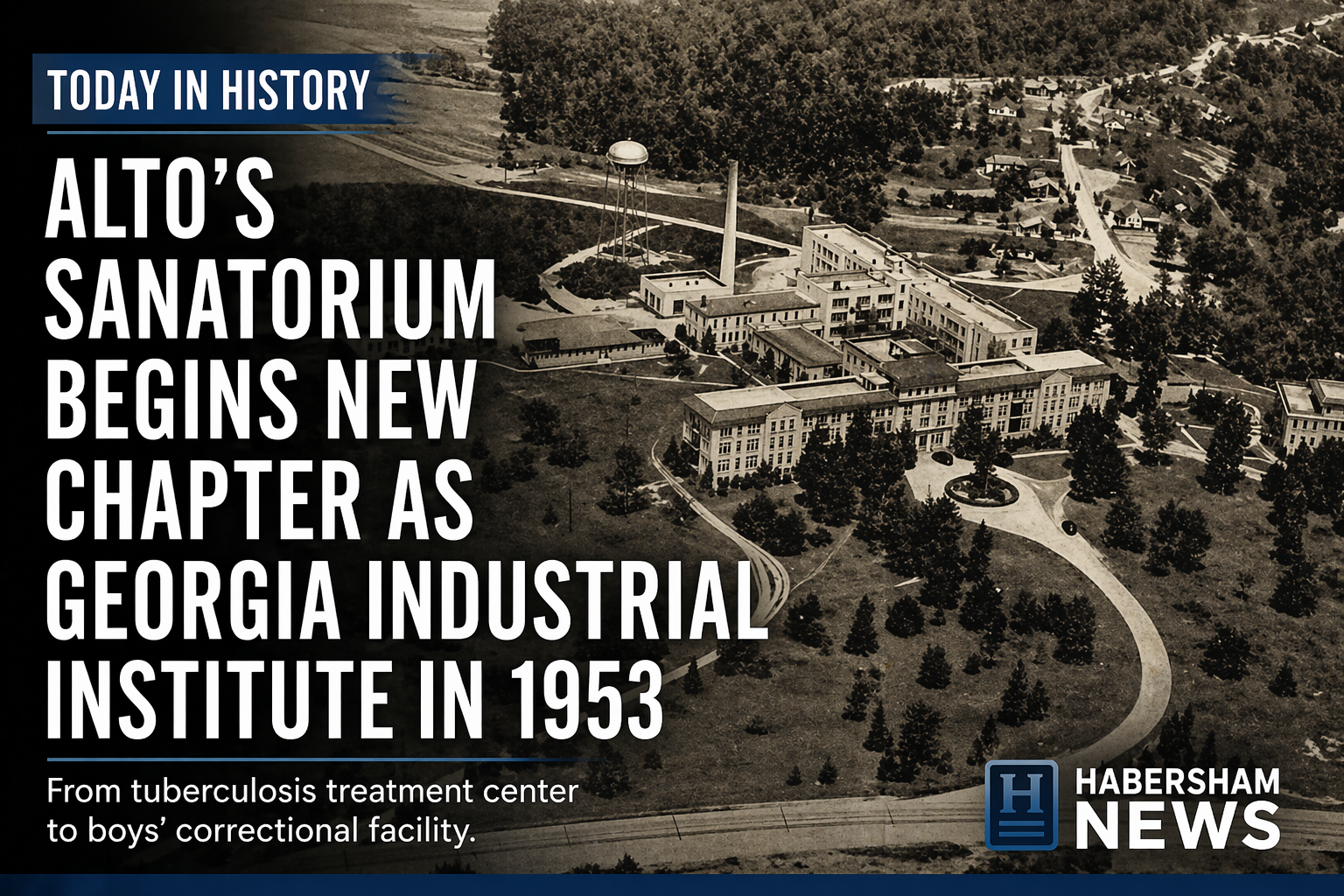

Seventy-three years ago, a major transition was underway in Habersham County—one that reflected changing medical science, shifting public policy, and a new chapter for a facility that had long stood on the hills of Alto.
On April 23, 1953, newspapers reported that the Georgia Department of Corrections was preparing to take over the former Alto medical facilities and convert them into a boys’ correctional institution known as the Georgia Industrial Institute.
From Isolation to Institution
Long before it became a correctional facility, the Alto campus served a very different purpose.
The site was home to the Georgia State Tuberculosis Sanatorium, a sprawling complex built in the early 20th century to combat one of the most feared diseases of the era. Tuberculosis—often called the “white plague”—was highly contagious and often deadly, leading states across the country to construct isolated sanatoriums where patients could receive long-term care.
The Alto facility dates back to at least the early 1900s, with records showing it existed as early as 1911 and continued expanding in the decades that followed.
By the 1920s, it had become a fully developed state-run treatment center, with cottages, staff housing, and medical buildings spread across the property.
A Sudden Move in the 1940s
By the mid-1940s, advances in medical treatment—particularly antibiotics like streptomycin—began changing how tuberculosis was treated.
In June 1946, the state made a dramatic decision: patients and staff were relocated from Alto to Rome, effectively ending Alto’s role as a primary tuberculosis treatment center.
The move marked the beginning of the end for the sanatorium as a medical facility. What had once been a place of long-term isolation and treatment was suddenly left without its original purpose.
A New Purpose: Georgia Industrial Institute
By 1953, the state had decided what would come next.
According to contemporary reporting, the former hospital would be repurposed into the Georgia Industrial Institute (GII), a boys’ correctional and training facility operated under the Department of Corrections.
The transition involved relocating a youth training program from Toccoa to Alto, with plans to expand capacity and staff. The facility was expected to house hundreds of young inmates and provide vocational and educational training.
The decision reflected broader trends of the era—repurposing large, state-owned institutional campuses for new uses as older systems became obsolete.
A Site of Many Histories
The Alto campus would go on to serve multiple roles over the decades—first as a tuberculosis sanatorium, later as a correctional facility, and eventually as part of Georgia’s evolving network of state institutions.
Each phase tells a different story:
- A time when tuberculosis shaped public health policy
- A moment when medical advances made isolation hospitals less necessary
- And a shift toward using the same grounds for rehabilitation and corrections
Looking Back
Today, the story of Alto’s transformation is a reminder of how quickly institutions can change with the times.
What began as a place of healing became a place of discipline and reform—reflecting both the progress of medicine and the changing priorities of the state.
And on this day in 1953, that transformation was just beginning.