

A new documentary highlighting one of Habersham County’s most celebrated figures will air tonight on Georgia Public Broadcasting.
“Stalking the Big Cat of Georgia,” a film by Georgia filmmaker Hal Jacobs, is scheduled to air at 10 p.m., bringing the story of Hall of Famer Johnny Mize to a statewide audience.
A Local Legend On The Big Screen
Mize, known as the “Big Cat,” was born and raised in Demorest and went on to become one of Major League Baseball’s most dominant hitters during the sport’s Golden Age.
Over a 15-year career, Mize played for the St. Louis Cardinals, New York Giants, and New York Yankees, where he helped the Yankees win five consecutive World Series titles from 1949 to 1953.
Widely regarded as one of the best power hitters of his era, Mize later waited nearly three decades before finally being inducted into the Baseball Hall of Fame in 1981.
But beyond the numbers, the documentary explores a deeper story—one rooted in North Georgia, race relations during the Jim Crow era, and the broader baseball culture of the time.
Inside The Documentary
Directed by Jacobs, the 55-minute film takes a behind-the-scenes look at author Jerry Grillo’s decades-long effort to write a biography of Mize and uncover lesser-known aspects of his life.
The documentary also examines Mize’s experiences playing alongside and against Black and Latin American players during a segregated era—adding historical depth beyond the typical baseball narrative.
Jacobs has described the project as more than just a sports documentary, focusing on community, history, and the people who keep local legacies alive.
Local Screening In Demorest
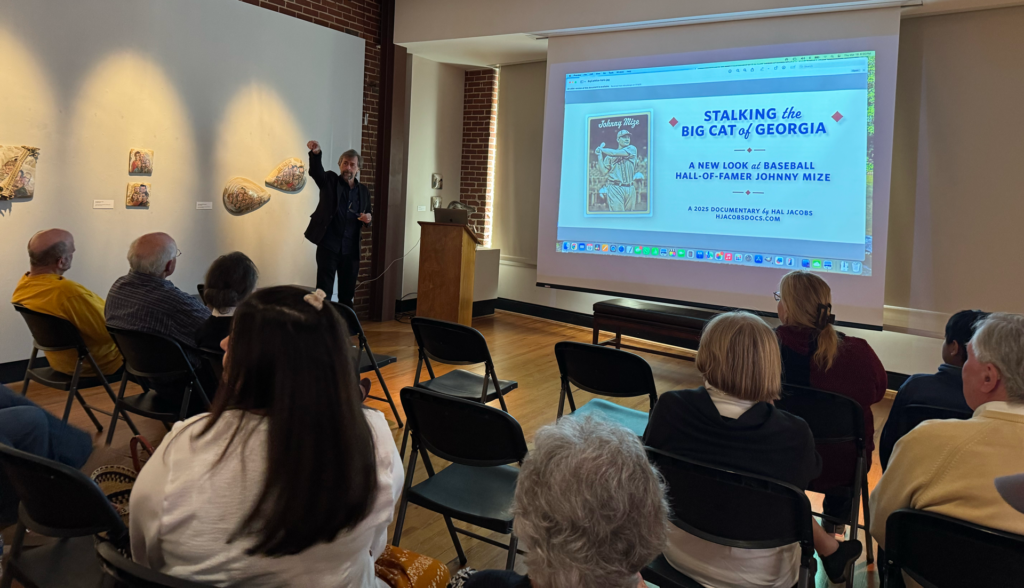
The film has already drawn local interest, including a recent screening at the Mason-Scharfenstein Museum of Art on the campus of Piedmont University.
That showing gave Habersham residents a chance to see the story of their hometown legend on the big screen before its broader television debut.
About The Filmmaker
Jacobs, a Georgia-based writer and director, has produced multiple documentary films since 2014, focusing on subjects tied to the state’s history, arts, and social issues. His work has been featured on public television and screened at film festivals, libraries, and community venues across Georgia.